

Understanding Your Car’s Brake System Guide
By George Automotive Editorial Team · Updated 2026-09-03
Braking systems use hydraulic pressure to force brake pads or shoes against rotors or drums, creating friction that stops the vehicle. Most vehicles combine front disc brakes with rear drum or disc brakes. Warning signs include steering wheel vibration, squealing, or pulling. George Automotive provides expert brake repair and services in Danville and Bloomsburg, PA, but the provided sources do not mention complimentary safety checks.
How Car Brake Systems Work: Essential Basics
- Modern cars use hydraulic systems to operate brakes on all four wheels for complete vehicle stops.
- Front brakes handle greater stopping responsibility than rear brakes because braking weight transfers forward.
- Disc brakes and drum brakes represent the two primary braking system types in passenger vehicles.
- George Automotive in Danville, PA employs 16 technicians who service both disc and drum brake systems.
How Does Your Car’s Brake System Work?
Friction does the heavy lifting. Every time a driver presses the pedal, the brake system guide to physics is simple: kinetic energy from spinning wheels converts into heat, and that heat brings the car to a stop. Without this energy transfer, a moving vehicle would keep rolling until something else stopped it.
Four wheels, one connected system. Most modern vehicles distribute braking power across all four corners through a hydraulic system, meaning fluid pressure — not muscle alone — does most of the work when a driver steps on the pedal. This setup gives cars balanced, predictable stopping power rather than relying on just the front or rear wheels.
Once car brakes explained in plain terms, one fact stands out above the rest: brakes rank as the most critical safety system on any vehicle. Underperforming brakes turn an ordinary commute in Danville or Bloomsburg into an unnecessary gamble. A soft pedal or a delayed response isn’t a minor inconvenience — it’s a risk multiplier.
What Are the Main Brake Components That Make This Happen?
The core brake components work together as a chain. A weak link anywhere in that chain compromises the whole system.
- The pedal, which starts the hydraulic pressure
- Fluid lines, which carry that pressure to each wheel
- Friction materials at the wheels, which convert motion into heat
Why Does Brake Maintenance Matter So Much?
Because the system relies on precise coordination, small wear issues escalate fast. George Automotive treats every inspection with the same attention given to family vehicles, serving Danville, Bloomsburg, and nearby communities with that same standard. Safety stays the priority on every visit.
What Are the Main Brake Components?
Two braking designs handle most of the stopping power in Danville and Bloomsburg vehicles: disc brakes and drum brakes. A quick understanding of these brake components helps drivers spot trouble before it becomes a breakdown.
Disc brakes work through friction at the wheel. A brake pad clamps against a spinning rotor whenever the driver presses the pedal, slowing the wheel through direct contact. This design dominates modern vehicles because it manages heat well and responds quickly.
Drum brakes take a different approach. Brake shoes press outward into a rotating drum, creating the friction needed to bring the car to a stop. Many vehicles still use this setup on rear wheels, pairing it with front disc brakes for balanced performance.
| Component | Function |
|---|---|
| Brake pad | Presses against rotor to create friction |
| Rotor | Spins with the wheel; absorbs pad pressure |
| Brake shoe | Pushes outward into the drum |
| Drum | Encases shoe assembly; generates stopping friction |
How do pads and rotors differ from shoes and drums?
Pads and rotors sit on the outside of the wheel, making inspection and replacement more straightforward. Shoes and drums work inside an enclosed housing, so wear often goes unnoticed longer without a trained eye checking them.
Why does understanding these parts matter for everyday drivers?
Recognizing the difference helps drivers describe symptoms accurately during a service visit, speeding up diagnosis. It also clarifies why some repairs cost more than others depending on which system needs attention.
George Automotive’s ASE-certified technicians inspect pads, rotors, calipers, lines, and fluid using state-of-the-art diagnostic tools during every brake visit. This thorough approach in this brake system guide ensures nothing gets missed. Every recommendation stays honest, transparent, and free of unnecessary upsells.

Disc or Drum: What’s the Difference?
Disc brakes and drum brakes represent the two core brake components found on passenger vehicles today. Disc brakes rely on calipers squeezing brake pads against a spinning rotor. Drum brakes use shoes that press outward against the inside of a metal drum. Understanding this distinction forms the foundation of any solid brake system guide, since the two designs behave differently under stress.
Most vehicles on Danville and Bloomsburg roads pair the two systems rather than using one exclusively. Front wheels typically get disc brakes, prized for their efficiency, while rear wheels often rely on drums instead. That layout makes mechanical sense — braking shifts weight forward, so front wheels handle more stopping force and benefit from a quicker, more responsive system.
Why don’t all cars use disc brakes on every wheel?
Some do. All-disc setups appear on high-performance and luxury models, where stopping power and heat dissipation matter most. Older or smaller vehicles sometimes stick with all-drum systems instead, since drums hold up fine under lighter, everyday driving.
Which brake type is more common today?
Disc brakes serve as the standard across most vehicles on the road. Steel rotor discs and calipers create the friction needed to slow the wheels, delivering better heat management than drums typically offer.
| Feature | Disc Brakes | Drum Brakes |
|---|---|---|
| Common placement | Front axle (some all four) | Rear axle on many models |
| Typical vehicles | Newer, performance, or luxury cars | Older or smaller cars |
| Efficiency | Generally higher | Generally lower |
These car brakes explained basics matter for daily drivers, too. Knowing which system sits on each axle helps explain why a mechanic often recommends different service schedules for front versus rear brakes.
What Warning Signs Signal Brake Trouble?
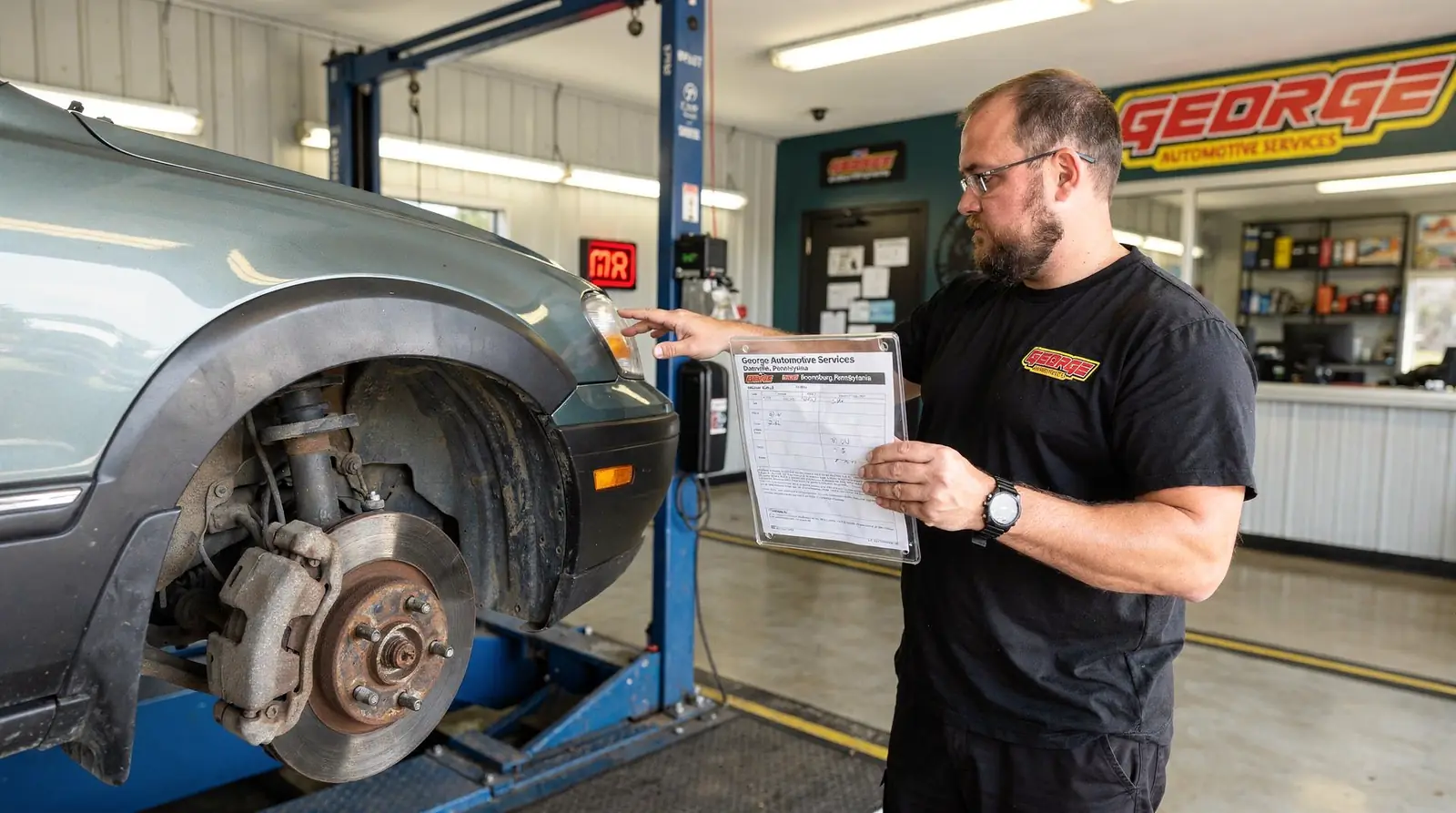
Five symptoms point to worn brake parts: steering wheel vibration, a pedal that requires heavy pressure, loud grinding or squealing, a car that pulls to one side, and a brake warning light on the dashboard. Ignoring these signs costs drivers in Danville and Bloomsburg more than money. It costs stopping distance when it matters most. A vehicle that pulls left under braking, for instance, often signals uneven pad wear or a sticking caliper, both of which worsen quickly without attention.
How does a mechanic know what’s actually wrong?
Diagnosis starts with a hands-on inspection, not guesswork. George Automotive’s technicians examine the full braking system. Prepare a complete diagnostics report, then walk through the findings with the customer before any repair begins. That conversation matters: drivers see exactly what needs fixing and why, rather than receiving a vague estimate.
Why bother with regular brake checks if nothing feels wrong yet?
Brake components rarely fail without warning — the trouble builds gradually, often below the surface. A transparent inspection catches uneven pad wear or early rotor scoring before it turns into grinding metal or a spongy pedal.
Routine service delivers measurable benefits:
- Prevents uneven wear across pads and rotors
- Shortens stopping distances for safer reaction time
- Eliminates squealing and grinding noises
- Avoids costly rotor replacement or hydraulic repairs later
Every inspection at George Automotive ends with a full, honest report covering everything that needs addressing. That approach turns a vague dashboard warning into a clear, actionable plan. And keeps drivers confident behind the wheel, whether commuting through Danville or running errands around Bloomsburg.
How Does George Automotive Keep You Safe?
Safety comes from thorough diagnostics, honest guarantees, and a location built for Danville and Bloomsburg drivers. George Automotive specializes in a complete brake system guide approach. Diagnostics, repairs, and preventive maintenance covering all makes and models. Skipping worn brake parts risks longer stopping distances. That gap can mean the difference between a close call and a collision.
Every repair carries a a notable share satisfaction guarantee, so drivers never wonder whether the work was done right. That commitment reflects a shop willing to stand behind its labor rather than hand customers a bill and a shrug.
Does George Automotive handle PennDOT inspections?
Yes. George Automotive operates as the fastest official PennDOT Inspection Station, which means drivers avoid the yearly scramble to find a slot elsewhere. Staying compliant becomes simple instead of stressful.
What happens while my car is in the shop?
Shuttle service keeps daily routines moving. Nobody has to sit in a waiting room for hours just because a car needs attention.
Brake care at George Automotive breaks down into a few reliable commitments:
- Comprehensive brake components coverage — pads, rotors, calipers, and full systems diagnosed and repaired for any make or model
- Simple pad swaps, full brake jobs, or emergency fixes, all handled quickly and affordably
- A shop location in Danville, PA, giving nearby Bloomsburg drivers a trusted option close to home
- Shuttle service so waiting around isn’t required
For drivers who want their car brakes explained in plain terms before work begins, George Automotive walks through findings and gets approval first. That transparency, paired with a satisfaction guarantee and a nearby location, turns brake maintenance from a dreaded chore into a straightforward stop on the way to somewhere else.
FAQ
What is the difference between disc brakes and drum brakes?
Disc brakes use a pad that clamps against a spinning rotor, managing heat well and responding quickly. Drum brakes use shoes that press outward into a rotating drum. Many vehicles pair this setup on rear wheels with front disc brakes.
What warning signs indicate brake problems?
Steering wheel vibration, squealing, and pulling signal brake trouble. George Automotive recommends addressing these signs promptly, since underperforming brakes turn an ordinary commute into an unnecessary risk.
Where does George Automotive provide brake repair services?
George Automotive, located in Danville, PA, provides expert brake repair and services in Danville and Bloomsburg, PA. The shop employs 16 technicians who service both disc and drum brake systems.
Conclusion
In closing, understanding your brake system empowers you to recognize warning signs early and make informed decisions about your vehicle’s safety. Regular inspections and prompt attention to brake concerns protect you, your passengers, and everyone sharing the road. Our certified technicians stand ready to diagnose brake issues, explain findings clearly, and deliver the reliable repairs your vehicle deserves—because your safety matters most to us.